🏆 Editor's Choice
 Reviewed by Marcus Knapman, BSc (Hons) Computing ·
Researched from 100+ Amazon customer reviews
· How we review
Do you actually need a 15-inch laptop? It's a question I ask whenever a big-screen ultraportable lands on my desk, because most of us spend more time squinting at a cramped 13-inch panel than we'd care to admit. The Apple MacBook Air 15-inch with the M5 chip is Apple's answer for people who want room to breathe without lugging a brick around.
I haven't had this one on my own desk for a month, so let me be clear about my method. I've gone through the full spec sheet, read through a large pile of owner feedback on Amazon, and compared what Apple claims against what buyers of earlier Airs tend to say in practice. The Amazon star rating isn't available for this particular listing yet, so I'm leaning on the specs and the track record rather than a headline number.
The bottom line, in my view: this is a very good laptop at a price that stings only a little less than it did last year. At £1,349.97 you're getting 16GB of unified memory and a 512GB SSD as standard, which means the base configuration isn't the cut-down compromise it used to be. If you want one machine that handles work, travel and the odd bit of photo editing without a fan screaming at you, this is a strong contender. If you're on a tighter budget, read on, because there's a catch or two.
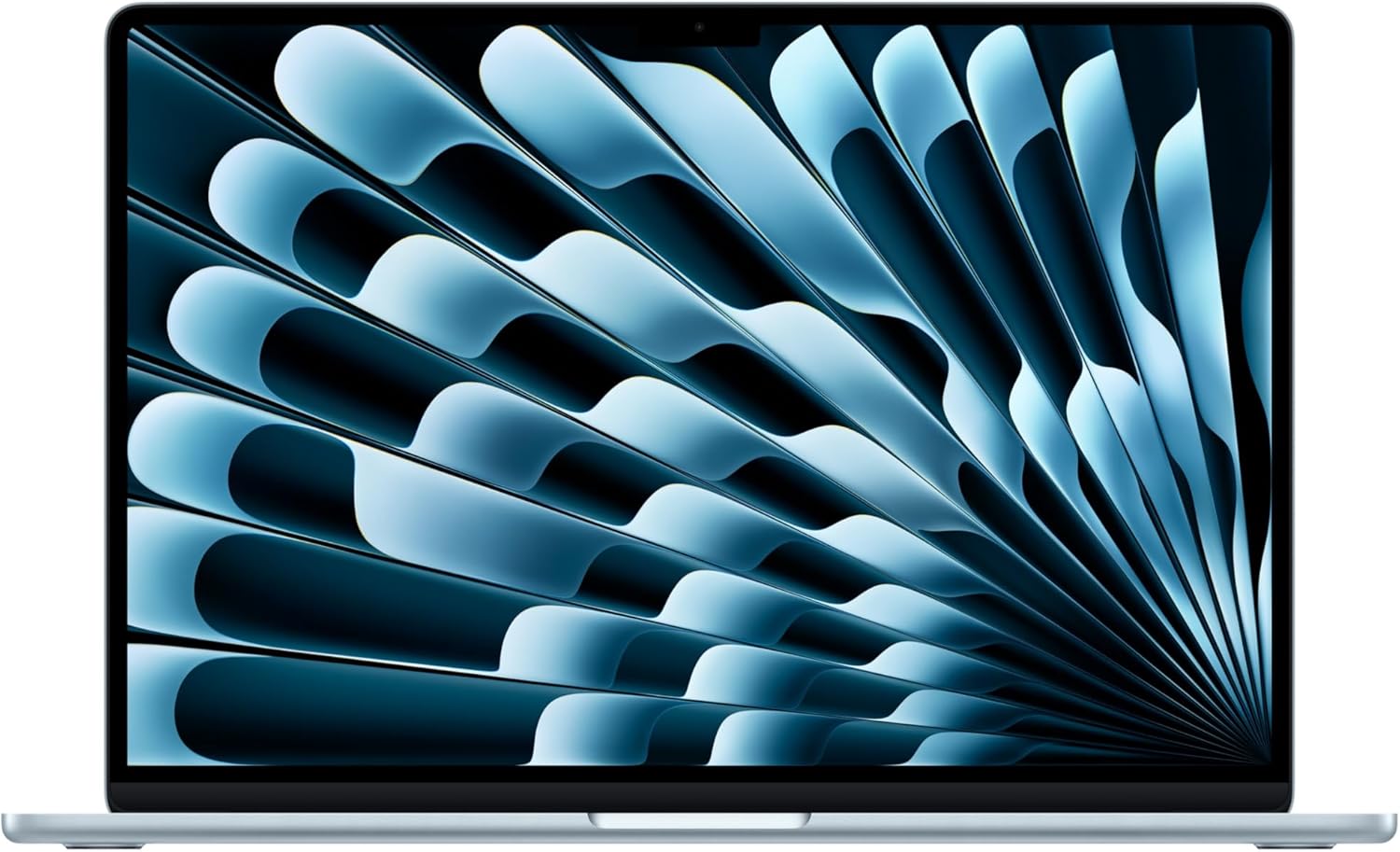
Let's start with why you'd pick this over the smaller Air. The 15.3-inch Liquid Retina display is the headline, and Apple says it supports 1 billion colours. On paper that means rich contrast and crisp text, and it's the sort of panel that makes spreadsheets and split-screen windows far less of a chore. If you regularly have a document open beside a browser, the extra real estate is the sort of thing you stop noticing and then miss terribly when it's gone.
It's also a proper treat for video and photo work. You can see more of your timeline, more of your canvas, more of whatever it is you're fiddling with. I'd argue the bigger screen does more for everyday comfort than any chip upgrade.
The M5 chip is the engine here, with a faster CPU and a next-generation GPU that includes Neural Accelerators for AI tasks. I'll be straight: for most people, raw speed was never the problem with recent Airs. The more interesting detail is the 16GB of unified memory in the base spec. Memory is where thin laptops used to get squeezed, and having 16GB from the start means browser tabs, a music app and a chunky editing project can coexist without the whole thing grinding to a halt.

The 512GB SSD is a sensible starting point too. It's not enormous if you shoot a lot of video, but it's a far cry from the stingy entry-level storage that used to make the cheapest Mac feel like a trap.
Apple quotes up to 18 hours of battery life, and as always you should treat that as a best-case figure achieved under specific conditions. Reading through owner feedback on previous Airs, the consistent theme is that a full working day away from the plug is realistic, and that the laptop stays quiet while doing it. That silence is a quiet luxury if you work in libraries, trains or a house where someone's trying to watch telly.
The MagSafe port is worth a mention as well. It frees up the two Thunderbolt 4 ports and, more practically, it means a tripped cable pulls away rather than dragging your pride and joy off the table.
Here's where I'll grumble. Two Thunderbolt 4 ports, a MagSafe socket and a headphone jack is the full list. That's it. No SD card slot, no HDMI, no USB-A. If you plug in a monitor and a dock you'll be reaching for dongles, and at this price I'd have liked a bit more generosity. It does support up to two external displays, which is handy, but you'll want to budget for an adapter or hub.

On the wireless side, the Apple N1 chip brings Wi-Fi 7 and Bluetooth 6. Whether you have a Wi-Fi 7 router at home is another matter, and plenty of UK households don't yet, so consider it future-proofing rather than an immediate gain.
The 12MP Center Stage camera keeps you in frame as you move about, and Desk View lets you share a top-down shot of your workspace, which is a neat trick for demos or showing off a sketch. Add the three-mic array and a six-speaker system with Spatial Audio and Dolby Atmos, and you have a laptop that's genuinely pleasant for calls and casual film watching without reaching for headphones. For a machine this thin, that's a clever bit of engineering.
Apple is pushing the AI angle hard, and Apple Intelligence is baked in, with privacy protections Apple says keep your data away from everyone, including Apple. It's a decent bonus for writing help and getting small tasks done quicker. But I wouldn't let the AI branding be the reason you spend over thirteen hundred pounds. The hardware stands up without it, and the software features will keep evolving whatever you buy today.
At £1,349.97 this isn't cheap, and it isn't pretending to be. You're paying for the larger screen, the polished build and the ecosystem. If you already own an iPhone, the way everything hands off and syncs is a real convenience. If you're coming from Windows and you just want a big screen and a good keyboard, there are cheaper ways to get there, though few that match the battery life and silence.
If you want a big, quiet, long-lasting laptop that does everything from emails to light creative work, the Apple MacBook Air 15-inch M5 is an easy recommendation. If you're tight on budget or need a full spread of ports, look at cheaper alternatives or budget for a hub.
As an Amazon Associate, Smart Trends earns from qualifying purchases.
Was this review helpful?


